Ground Illumination Craft
Pathway Luminaries
A walkway engulfed in black ice and drifting snow requires intentional guidance, not glaring floodlights. Ground lanterns act as visual waypoints that outline transitions between paths, stone steps, and garden borders. When designed properly, a series of low-wattage lanterns transforms a treacherous approach into an inviting arrival.
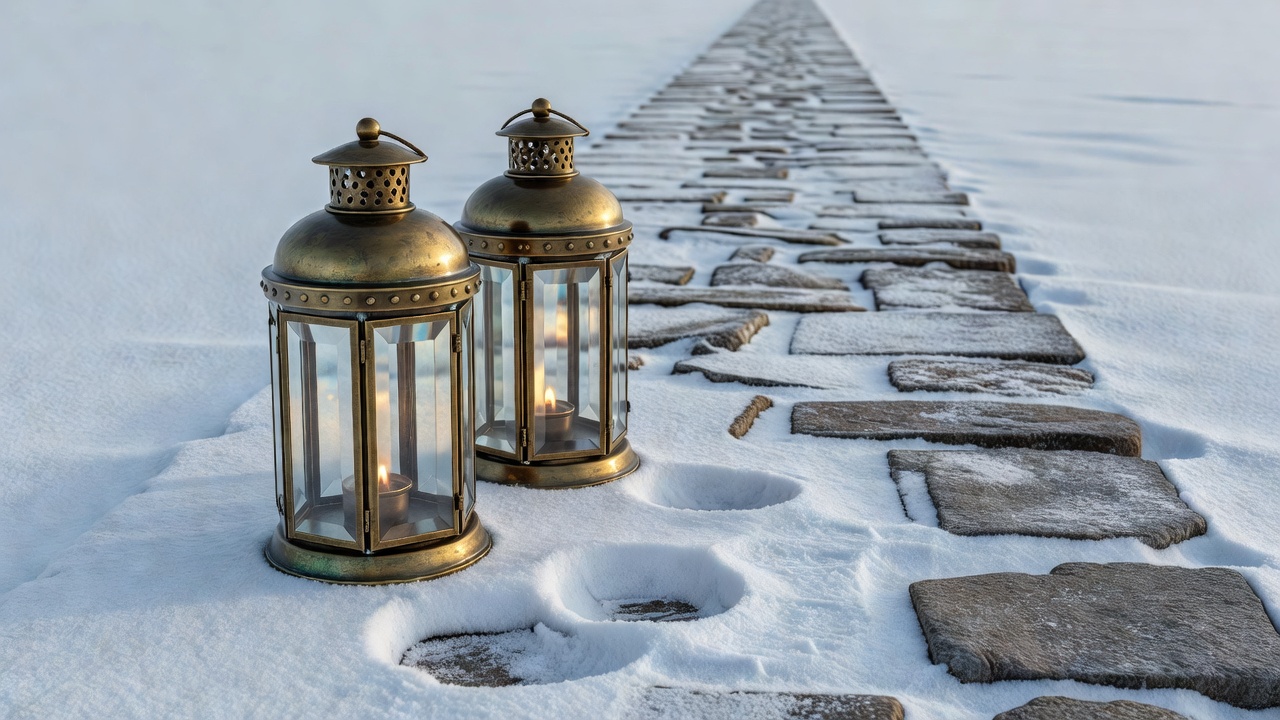
Material Superiority: Solid Brass vs. Thin Sheet Metals
The most common failure point of outdoor lanterns during deep winter is thermal cycling fatigue. Cheap steel or aluminum sheet fixtures with powder coatings crack when subjected to -20°C temperatures followed by internal candle heat or halogen bulbs. Moisture enters through microscopic fractures, freezing solid and buckling the seams.
Solid cast brass and heavy-gauge marine-grade bronze remain unaffected by these extreme temperature differentials. As brass ages, it develops a deep verdigris or dark tarnish patina that actually protects the underlying metal from salt spray, road grit, and moisture. For storm-prone sites, a minimum lantern weight of 3.5 kg is recommended to resist gusts up to 80 km/h without toppling.
Combustion vs. Solid-State LED Cores
Selecting between natural wax flame and solid-state low-voltage diodes depends primarily on site accessibility and maintenance routines:
Natural Wax Pillars in Storm Lanterns
Traditional paraffin or beeswax pillars produce an unbeatable living flicker with a natural color temperature of roughly 1850K. However, in freezing winds, combustion lanterns require balanced double-wall roof vents to maintain air intake without blowing out the wick. Use high-melting-point paraffin (58°C+) to prevent tunneling caused by subzero glass sidewalls chilling the outer wax rim.
Solid-State Low-Voltage Diodes
For permanent, zero-maintenance illumination, retrofitting vintage lantern frames with 12V or 24V AC/DC low-voltage LED chips provides unattended reliability. Specify diodes encapsulated in silicone potting compound to prevent condensation shorts during daily freeze-thaw cycles.
Spacing, Height & Contrast Ratios
Avoid the temptation to plant luminaries like runway lights every two meters. Instead, place fixtures at natural waypoints: gate posts, direction changes, low steps, and near textured stonework. An asymmetrical stagger (e.g., alternating sides every 4 to 6 meters) maintains depth of field while eliminating distracting glare tunnels.