High-Latitude Photovoltaics
Solar Winter Care
Many garden owners discard solar lanterns come November, assuming photovoltaic tech is useless during the shortest days of the year. While basic department-store solar spikes will indeed go dark by 17:00 due to tiny monocrystalline panels and cheap nickel-cadmium cells, purposeful winter care and proper equipment choices can deliver 4 to 6 hours of dependable evening illumination even in northern winters.
The Chemistry Bottleneck: LiFePO4 vs. Standard Lithium-Ion
The primary reason solar fixtures fail in subzero weather is not a lack of light, but battery physics. Standard Lithium-ion (Li-ion) and old NiMH batteries lose up to 60% of their operational capacity when temperatures fall below 0°C. Charging them under freezing conditions can cause irreversible lithium plating, permanently destroying the cell within weeks.
High-grade architectural solar lanterns specify Lithium Iron Phosphate (LiFePO4) chemistry paired with low-temperature charge controllers. LiFePO4 cells tolerate extreme cold cycles far better and offer more than 2,000 charge cycles compared to just 300 to 500 for standard consumer cells.
Panel Tilt Angle and the 60-Degree Rule
Summer solar panels are typically oriented at a gentle 30-degree incline to catch midday sun overhead. In winter, two critical factors demand a drastic change:
- Low Solar Elevation: In December and January across latitudes above 50°N, the midday sun barely clears the southern horizon. Panels tilted at 55° to 65° face the sun directly rather than glancing off at an inefficient angle.
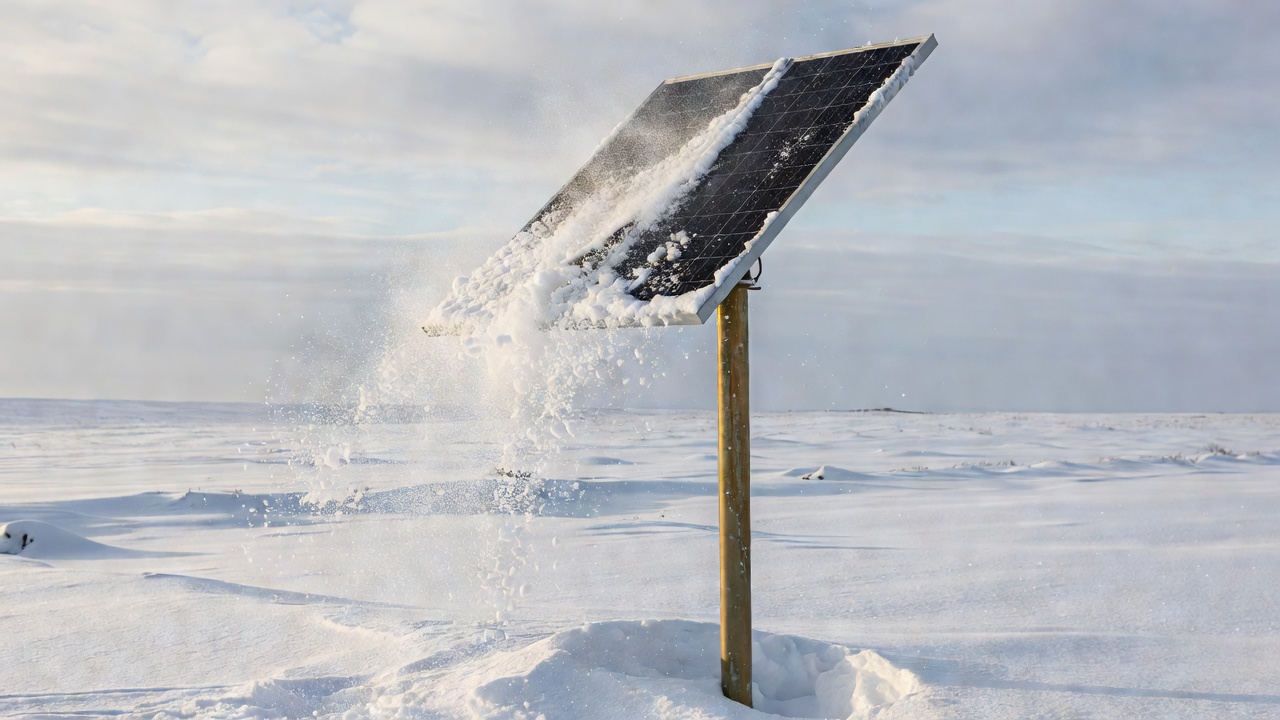
- Passive Snow Shedding: Panels mounted at 60 degrees naturally slough off dry powder snow. Snow cannot easily build up on steep, smooth tempered glass, keeping the collector surface clear without manual brushing.
Winter Maintenance Checklist
Perform a brief monthly inspection to ensure maximum solar collection:
1. Surface De-Icing: Never scrape solar glass with metal blades or stiff ice scrapers. Use a soft silicone squeegee or lukewarm (not boiling) water to remove stubborn frozen crusts without scratching the anti-reflective glass coating.
2. Remote Panel Placement: If lanterns are located in deep courtyard shadows or under evergreen canopies, use fixtures featuring separate remote solar panels connected via 5-meter low-voltage cable, positioning the collector on an unshaded south-facing fence or shed roof.